
Literal, word for word
Each sutta and its commentary are translated as the Pāḷi states them, straightforwardly and accurately, with nothing added by way of explanation; analysis is kept to the exceptions and commentary to the footnotes.
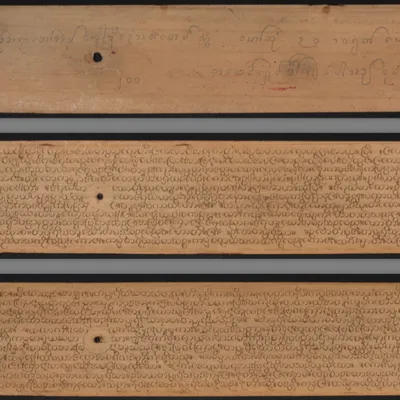
Pāḷi is the language of the Theravāda Buddhist canon, the Tipiṭaka, and of the commentaries, chronicles and grammars that grew up around it. The word itself means “text”, and came to name the language the texts are written in. It is a Middle Indo-Aryan language, one of the Prakrits that stand between Sanskrit and the modern languages of India, and a composite one, drawing on eastern, western and north-western dialects; the tradition, following Buddhaghosa, identified it with Māgadhī, the speech of the Buddha’s homeland. Pāḷi has forty-one letters, eight vowels and thirty-three consonants, arranged by the place and manner of their articulation. It has no script of its own: it has been written in the scripts of Sri Lanka, Burma, Thailand and Cambodia, all descended from Brāhmī, and today in Roman letters with diacritics. Its grammar was formalised by the grammarians of the sixth to twelfth centuries, beginning with Kaccāyana, whose rules describe the language in its own terms. A fuller account is given in the Pāḷi textbook on buddhavacana.
Kaccāyana is the earliest surviving Pāḷi grammar, traditionally ascribed to the Buddha’s disciple Mahākaccāyana and compiled around the sixth or seventh century CE. Two later works of its school are translated alongside it: Buddhappiya’s Padarūpasiddhi (thirteenth century), which recasts its rules in a teaching order with full inflection tables and the derivation of every form, and Dhammakitti’s Bālāvatāra (fourteenth century), the primer for beginners that abridges both. The three texts are translated in one style and cross-referenced rule by rule, so that a Kaccāyana sutta, Buddhappiya’s treatment of it and Dhammakitti’s abridgement are always a click apart.
The aim of this site is a literal, word-for-word translation of these core texts of the classical Pāḷi grammatical tradition: the rule and its commentary are rendered as the Pāḷi states them, straightforwardly and accurately, with nothing added by way of explanation and nothing left out. Their accuracy has been checked rigorously: every sutta was read against the Pāḷi, cross-checked with the earlier human translations reproduced on this site, checked again with two language models, the MITRA-QWEN Pāḷi–English model of the Dharmamitra project and Anthropic’s Claude Fable, and finally cross-checked word by word against the Digital Pāḷi Dictionary: every word of every example, sentence and verse looked up, its meaning and its parse compared with the English; where a reading or a construal differs, a footnote says so.
Literal, word for word
Each sutta and its commentary are translated as the Pāḷi states them, straightforwardly and accurately, with nothing added by way of explanation; analysis is kept to the exceptions and commentary to the footnotes.
Modern terminology
The grammar is described in its own terms, in modern natural English: inflection forms ①…⑦ with ⨀ singular and ⨂ plural rather than Latin cases and declensions, and every technical term kept in Pāḷi and explained.
Optionality as the tradition read it
Every vā, kvaci, navā and vibhāsā is analysed after Aleix Ruiz-Falqués’ account of the two levels of optionality: an open option, or one restricted to a stated domain.
Worked examples
Every example is derived step by step, rule by rule, and its Tipiṭaka source is cited and linked to tipitaka2500.github.io; counter-examples explain what a rule does not do.
Cross-checked
Every sutta read against the Pāḷi, cross-checked with the earlier human translations reproduced on this site and with the editions and commentaries they report, checked again with the MITRA-QWEN and Claude Fable models, and cross-checked word by word against the Digital Pāḷi Dictionary; where a reading or a construal differs, a footnote says so.
Structure made visible
Diagrams of the kinds of rule, maps of each text onto Kaccāyana’s chapters, decision charts for sandhi, and taxonomies of compounds, suffixes and model nouns.