
Review of Thitzana, Kaccāyana Pāli Grammar (2016)
A Long Felt Need1
Section titled “A Long Felt Need1”The publication of a new integral and fully annotated translation of the Pāli grammar of Kaccāyana (Kacc) is something to be celebrated, for this has been a long felt need in the field of Pāli studies. This new edition and translation is the work of Venerable Ashin U Thitzana, a well versed scholar in the Pāli grammatical tradition. U Thitzana was trained at the Masoeyein (Asokārāma) Monastery in Mandalay, reputedly one of the most prestigious pariyatti academies in the Theravāda world. Apart from his solid scholastic training, the author has many year’s experience as a Pāli teacher with a Western audience.
The work is presented in two volumes of considerable size. The first volume (408 pp.) bears the title The Complete Text, it includes a Foreword that gives a general introduction to the Kaccāyana grammatical tradition within Pāli literature; a table of The Pāli Alphabets, including Roman, Devanagari and Burmese scripts in one single chart; a Pronunciation Guide; the Text of the Kaccāyana Vyākaraṇa, that is, the suttas only, in the main scripts: Roman, Sinhalese, Thai, Burmese and Devanagari; and subsequently the entire Kaccāyanasutta accompanied by its gloss, the Kaccāyana-vutti (Kacc-v), in Roman script only; the volume ends with Appendices containing summary lists of nominal and verbal affixes and a guide to nominal derivation according to the traditional methodology.
The second volume (889 pp.) contains a Preface and an Introduction with preliminary remarks on the goal of the present edition and the history of the Pāli language and grammar. The volume also includes a Pronunciaton Guide identical to the one in the first volume; a Guide to Conjuncts, i.e. sandhi; a Key to Entries explaining in detail the different fields of information in the analysis of every sutta and commentary; a List of Abbreviations of grammatical terms such as “ns. = nominative singular,” etc.; a short but useful glossary of Frequently Found Words and expressions that are typical of the grammatical style; then again the sutta text alone in two scripts: Roman and Devanagari; and finally the text of Kacc and Kacc-v with the translation and notes; this volume also includes Appendices with guides to nominal and verbal word formation, some remarks on the concepts of kāraka and sādhana, a list of parallel suttas (“similar suttas”) in Kacc and Pāṇini grammars, a Kaccāyanadhātvāvalī, that is, The Index of Roots in [the] Kaccāyana Text with their main meaning(s), arranged in the Pāli alphabetical order, more reader-friendly than the traditional arrangement of the Dhātumañjūsā2 text; the volume ends with an Index of topics and grammatical concepts.
The main motivation of this book is to present Kaccāyana as a grammar that can be used for the study of Pāli language. As the author himself states in his introduction:
The study of Pāli, the spoken language of the Buddha, is a worth-while and wholesome pursuit for anyone with a sincere heart and an inquiring intellectual mind whose apparent aim and purpose is to explore and understand Buddha’s spoken words. (Vol.2, p.1)
The author adds that in his years of teaching Pāli grammar to Western students, their struggle with Pāli motivated him to provide some learning tool. U Thitzana’s work appears in the milieu of a meditation community, not an academic community. This is a growing trend as more and more practitioners demand tools for pariyatti training.
Furthermore the author states that his intention is “not only to translate all of the whole text but also to contemporize an ancient grammar and its contents for the contemporary world.” This goal is partly achieved, although scholars should not expect the usual academic standards.
Due to the sheer amount of materials included in a single publication, U Thitzana’s Kaccāyana offers certain advantages over previous works in the field of Pāli grammar. Indeed, the work could be seen as a “milestone” (vol.2, p.4) in the modern history of Kaccāyana studies in European languages. Even though this history is not explained in U Thitzana’s introduction, he is well aware of it and makes explicit his attempt to supersede previous works such as Senart (1871) and Vidyabhusana (1901) (vol.2, p.3). The following survey of Kaccāyana studies in the West may be helpful to situate U Thitzana’s work in this modern tradition.
A Survey of Kaccāyana Literature in European Languages
Section titled “A Survey of Kaccāyana Literature in European Languages”Pāli studies and Kaccāyana scholarship in European languages have roughly the same point of departure. In 1826, while residing at Ratnapura, George Turnour (1799–1843), at the time a British civil servant in Ceylon, obtained a manuscript of the Mahāvaṃsa from his instructor. Turnour edited and translated this text into English, and this became the first English translation of a Pāli text. In the introductory essay to his edition, Turnour laments that the Kaccāyana grammar was already lost.3
Not having the oldest Pāli grammar at hand, the first Western scholar to engage in the study of Pāli traditional grammar not for historical purposes but simply to learn the language was William Tolfrey (1778?–1817).4 He used the Bālāvatāra, an abbreviated recast of Kaccāyana composed in Sri Lanka in the 14th century by scholar-monk, sometimes referred to as Dhammakitti.5 Tolfrey had served in the British army in India until 1805, when he decided to visit his uncle Samuel Tolfrey in Ceylon. He obtained a post in the public service one year later. In 1813, by virtue of his fluency in Sinhalese, he was appointed as translator in Kandy. The recently created Bible Society of Ceylon entrusted Tolfrey with the revision of the Dutch translation of the Bible. Cecil Bendall has described Tolfrey’s meeting with the Dutch translation:
Struck by the unduly colloquial character of this version, he adopted the strange course of previously translating each verse into the classical Pali. It was probably this that led him to attempt the translation of the whole New Testament into Pali, a work which he had nearly completed at the time of his death. It was subsequently printed, but as a literary production it was of no great value. Tolfrey was, however, probably the first Englishman to study Pali, the most important of the languages of Buddhism, and he merits recognition as a pioneer.6
Tolfrey died on January 4, 1817, at the age of thirty-nine, “suddenly attacked by a violent disorder, which in less than a fortnight carried him off.”7 He left a number of grammatical notes from his study of Bālāvatāra. Perhaps due to the fact that he could not complete his work, his name has fallen into oblivion. But his notes were used by Benjamin Clough (1791–1853) when he wrote the first European Pāli grammar.8
The official “discoverer”9 of Kacc in the West was Francis Mason, an American Baptist missionary in the Karen division of Burma. His main purpose in learning Pāli was to improve his knowledge of Burmese (!), and also “to know what the founder of Buddhism actually taught.”10 This was not an exceptional approach at that time. As Urs App has shown, some of the early “orientalists” were very much driven by religious motivations and the quest for the original common language of humankind (the language that was supposedly lost as a punishment for the construction of the Tower of Babel).11
Mason’s Kachchayano, printed in 1868, is the first modern translation of this grammar in a European language. This edition is the first Pāli printed text using special Burmese types designed by the Baptist Press in Calcutta, together with Brahmi:
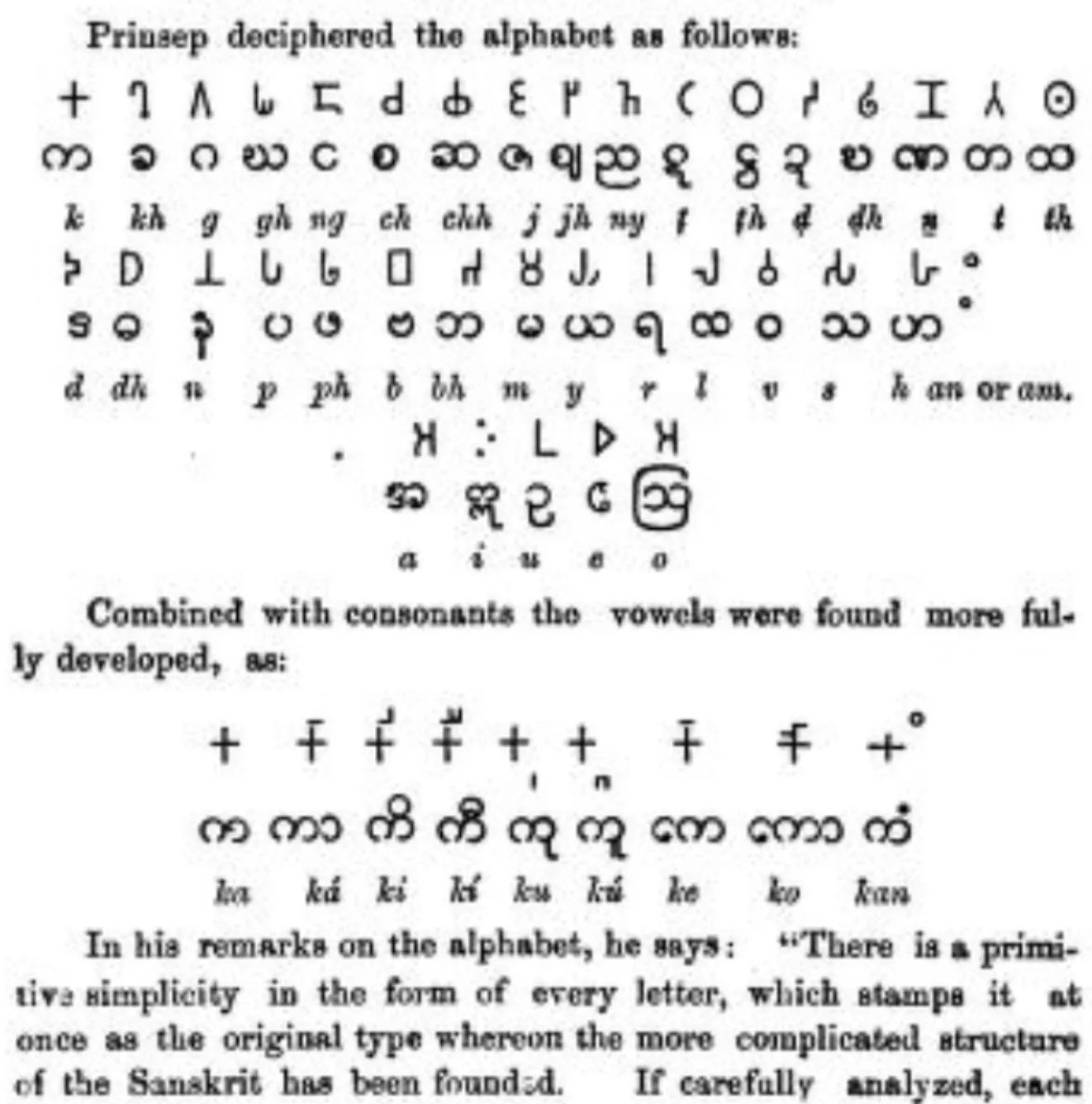
Example of Mason’s display of three different scripts, the addition of Brahmi is probably meant to confer on the Kaccāyana grammar a halo of great antiquity.
Far from being dismissive of the traditional vyākaraṇa methodologies, as some European scholars were, Mason recognises the great skill used in the systematic approach in Kacc and does not hesitate to compare it to modern feats of human ingenuity:
Kachchayano built his grammar precisely like the edifice of the Paris exhibition. He laid down the germ of his grammar in the centre, and then described around it several concentric circles, each containing all the things of a kind, and then struck out some seven hundred radii, crossing these circles, from the centre to the circumference, on each of which may be found every variety in the book, aphorism, paraphrase, example, exception or annotation, and commentary.12
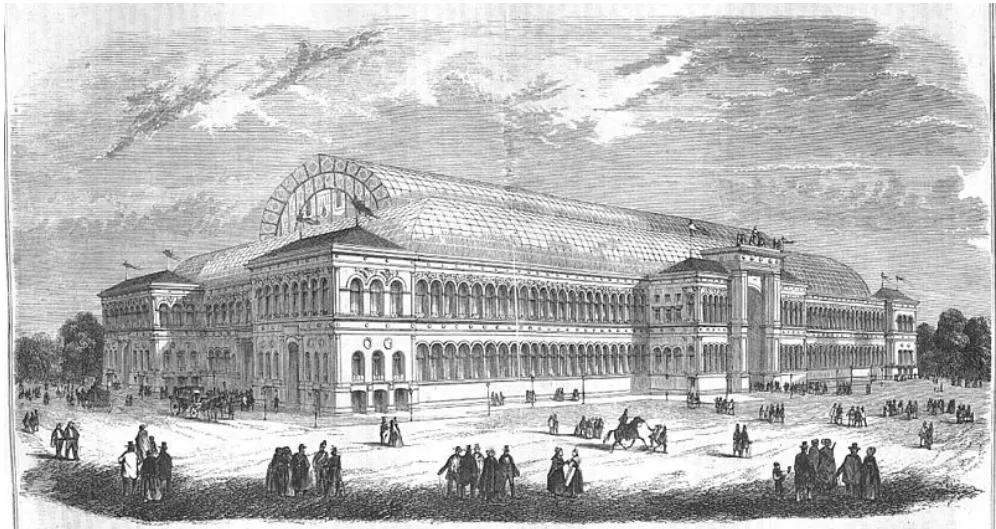
The Palais de l’Industrie of the Exposition Universelle in 1855, Champs Elysées, Paris. Mason compares the Kaccāyana System to this palace.
The next important name in the modern Kaccāyana renaissance is James D’Alwis (1823–187813), who had independently discovered the Kaccāyana text in Sri Lanka:
[I have used] Kachchàyana’s Grammar, which he [G. Turnour] then regarded as extinct. This, in the very outset of my Pali studies, after many years’ devotion to Sinhalese literature, I ascertained to be a mistake; having added it to my library, in a purchase of Pali books which I had then (1855) recently made from the collection of the late lamented F. D’ Levera, Esq., District Judge of Colombo.14
In 1863 D’Alwis published An Introduction to Kachchàyana’s Grammar of the Pali Language. This work is very rich in erudition and it’s completion is even more meritorious if we consider the conditions under which D’Alwis’ had to work:
Though living at “the very fountain of Pali literature”, I have, nevertheless, been unable to consult a single friend, either as to the choice of my language or the correctness of my renderings into English. I have indeed had much assistance from native Pandits, of whom I shall have occasion to speak hereafter, but none of them possess a sufficient knowledge of the English language…15
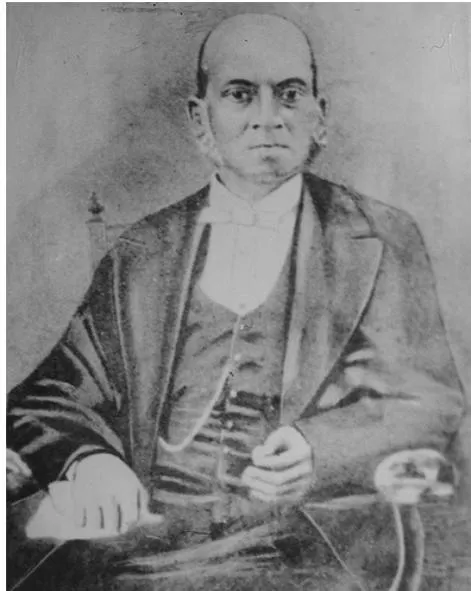
Sir James D’Alwis16
A few years later the Kaccāyana tradition began to grow in European soil. In 1869 the German scholar Ernst Kuhn published his doctoral dissertation with the title Kaccāyanappakaraṇae specimen (“An Excerpt of the Kaccāyana-vyākaraṇa”) which contains a Latin translation and a Pāli edition of Kacc kāraka chapter. This edition is based on manuscripts brought to Germany by the pioneer ethnographer Adolf Bastian, to whom Kuhn dedicates the edition: “Adolfum Bastian Indicopleusten” (“To Adolf Bastian, who sailed to India”). Bastian brought these manuscripts from Siam (“e Siamensium regno”) and they were written in Cambodian characters.17 A further edited portion of Kacc was published in 1871 under the title Kaccāyanappakaraṇae specimen alterum (“A Second Excerpt of the Kaccāyana-vyākaraṇa”). This piece contains a Latin translation of the nāmakappa.
Also in 1871 Emile Senart published his French translation of the full text of Kacc, along with the Pāli edition in Devanagari script, as well as the edition of the Kacc-v, with erudite comments and abundant references to the Rūpasiddhi, which Senart consulted in manuscripts. Senart’s translation, though imperfect and based on very limited manuscripts, has been up to today the reference translation in a European language. This may be ironical as he himself was rather dismissive of the traditional method of Kacc:
It seems that we are dealing with a collection of grammatical remarks rather than a methodical grammar in which every word would be considered for what is worth and the natural limits of each rule would be clearly defined.18 (My translation)
U Thitzana has compared Senart’s edition of the Pāli text with the standard edition in Sri Lanka and Southeast Asia without finding major differences. Pind’s 2013 edition shows, however, that the textual tradition is more complex. For the purposes of an introduction, U Thitzana is right and the modern text of Kacc is relatively consistent, but that is partly due to the influence of the printing press.
One of the most interesting references to the Kaccāyana literature in European scholarship is G.E. Fryer’s Note published in the Journal of the Asiatic Society of Calcutta in 1882. In his philological investigations, Fryer tries to ascertain whether Pāli is an old form of Māgadhī or not, in other words: if Pāli was the language spoken by the Buddha. In this Note Fryer outlines a historical sketch of the Pāli language using grammatical texts as sources. He is aware of the existence of several treatises. He divides them into two “schools”: Kaccāyana and Moggallāna. He calls Kaccāyana “Sáriputta Mahá Kaccáyana”. Fryer is also aware of the existence of the Nyāsa19 otherwise known as Mukhamattadīpanī, Vimalabuddhi’s great commentary on Kacc. He also seems to be acquainted with the tradition that ascribes the first sutta of Kacc to the Buddha. From Fryer’s following remark, it is clear that he has not studied the Nyāsa:
According to native tradition, Kachcháyana, also called Sáriputta, pursuant to the declaration of Buddha that ‘sense is represented by letters,’ proceeded with Buddha’s permission to Himavanta and there composed this grammar, which, from this reputed origin, is considered sacred. It is to be found in every monastery in Burma. The arrangement of the work is irregular. The aphorisms follow each other without any regard to system.20
Fryer has learnt in Senart’s edition that the author of Kacc must have had the commentary of Kātantra (Kātantravṛtti) in front of him. My impression, however, is that Fryer does not distinguish between Kaccāyana and the author of the vutti:
We may infer, therefore, from his having the Kātantra before him, that the author of Kachchāyana’s grammar did not live prior to the tenth century A.D.21
It is difficult to agree with Fryer in the exact date, but he is probably right in dating Kacc after the Kātantravṛtti of Durgasiṃha, which seems to belong to the 8th rather than to the 6th century C.E.
Fryer gives an interesting, yet awkward insight on why Kacc was believed to be a composition of the disciple of the Buddha:
[T]he founders of the two schools of Pāli Grammar assumed respectively the names of the right and left hand disciples of Gotama, viz., Sáriputta, and Moggallána. This may have given rise to the tradition that Kachcháyana’s grammar was written about 500 years before the Christian era.22
Fryer however does not take this tradition seriously. He believes that Kacc was composed in the 12th century by a Ceylonese “priest” called Sáriputta (he was probably thinking of the ṭīkā author). But the Ceylonese, says Fryer, ascribed an Indian origin to Kacc.23
Fryer was criticized by Hoernle24 mainly for not being familiar with Burnell (1875) and for giving an unjustifiedly late date to Kacc. In his reply, Fryer refers to a work mostly unknown outside Burma, the “Kaccāyanabhedaṭīkā”:
According to Ariyavaṃsa – who in 1439 A.D. wrote Kachcháyanabhedaṭīkā – the commentator Sanghanandi and Kachcháyana are the same person, and the illustrations are ascribed by him to Brahmadatta: for he says imāni suttāni mahākaccāyanena katāni vutti ca sanghanandīsaṃkhātena mahākaccāyanen’ eva katā, payogo brahmadattena kato ti. vuttaṃ c’etaṃ
kaccāyanakato yogo
vutti ca sanghanandino,
payogo brahmadattena
nyāso vimalabuddhinā [App. D’Alw. Introd. p. 104].25
Fryer is explicitly quoting from D’Alwis. It is doubtful that he himself knew the commentary. An important correction here: the authorship of Ariyavaṃsa, the 15th-century scholar, is very uncertain and not supported by references. From what is known, the Kaccāyanabhedanavaṭīkā is a much later work and it is anonymous.26 Furthermore, the famous verses are clearly a quotation from some work that the author of the navaṭīkā knows, but which work is not clear. Fryer seems to follow the prose interpretation of the navaṭīkā:
sutta + vutti by Kaccāyana Saṅghanandin
payoga by Brahmadatta
nyāsa by Vimalabuddhi27
What Fryer does not see yet is that the nyāsa is not a part of what we call the Kacc-v.
Another important name in early Kaccāyana studies is Albert Grünwedel (1856–1935). Grünwedel, better known today for his role in the Turfan expeditions, began his career as a Kaccāyana scholar. Being a disciple of Kuhn, it is possible that he took an interest in Pāli vyākaraṇa from his mentor. In 1883 Grünwedel publishes his doctoral dissertation, Das sechste Kapitel der Rūpasiddhi, being an edition of the sixth chapter of the Rūpasiddhi (the chapter on ākhyāta “verbal morphology”) from three Sinhalese mss. This work is to be considered among the first steps towards an understanding of the indigenous tradition. Grünwedel’s choice of the 6th chapter was perhaps meant to be a complement to D’Alwis 1863. Grünwedel does not even mention the Nyāsa in his introduction or in his profuse end-notes, despite the fact that Rūpasiddhi may have benefited from Vimalabuddhi’s work in great measure.
One of the earliest attempts at adapting the entire Kacc system into English was done by the unjustly forgotten Tha Do Oung,28 who was professionally a surgeon working in Arakan (northwest Burma), but he was also trained as a Buddhist scholar. Oung was a member of the Royal Asiatic Society (Ceylon). He studied Pāli with Emil Forchhammer at the Rangoon University. Oung produced a comprehensive and pioneering treatise of Pāli grammar based on Pāli sources. The manual is divided in four volumes:
- A Grammar of the Pali Language (after Kaccāyana), Vol. I, Containing Sandhi, Nāma and Kāraka, and Samāsa, Akyab Orphan Press, Akyab, 1899
- A Grammar of the Pali Language (after Kaccāyana), Vol. II, Containing Taddhita, Kita, Uṇādi, Ākhyāta, Upasagga and Nipāta particles, Pyigyi Mandine Press, Akyab, 1899
- A Grammar of the Pali Language, Vol. III, being a Dictionary of Pali word-roots, Pyigyi Mandine Press, Akyab, 1900
- A Grammar of the Pali Language, Vol. IV, Chandam, etc. Pyigyi Mandine Press, Akyab, 1902
Volume One, dedicated to Forchhammer, and Volume Two, dedicated the author’s parents, are based on Kacc and deal with Pāli grammar proper. They are not very different in scope from U Thitzana’s work. It seems that U Thitzana is not aware of the existence of Oung’s volumes.
The third volume (1900) is dedicated to the members of the Arakan Jubilee Club, of which Oung was Honorary Secretary by that time. It is a dictionary of dhātu-s “verbal roots” after the Pāli Dhātumañjūsā. Again, it bears similarities with U Thitzana’s work. The fourth volume (1902), is dedicated to none other than Fryer. This volume deals with alaṅkāra “figures of speech” and chandam “prosody.” It is based on the Pāli work Vuttodaya and its ṭīkā.
As a Burmese, Oung seems to have a deep insight on the relation between Pāli vyākaraṇa and Buddhist philosophy and hermeneutics:
The grammatical portion of Buddhistic literature is vast; so much so that more than a thousand aṅgās are taken up in elucidation of the original texts. In fact, the higher branches of the study of Pāli Grammar gradually merge into the subtle questions of the sublime Ethico-psychological philosophy of Buddhism.29
Oung’s grammar has never been reprinted, perhaps because it stands half way between a proper translation of Pāli treatises and a grammar of Pāli according to the principles of modern linguistics. Or it may be simply because of bad luck and the fact that the author was not a famous Indologist (he was not even a scholar by profession).
In 1901 the Mahabodhi Society, an institution whose fundamental principles were “archaeological and philological” and whose object was “to revive the philosophical study of the Pali religion in its native soil”30 publishes, through the labours of the Bengali pandit S.C. Vidyabhusana (1870–1920), a Devanagari edition of Kacc and Kacc-v accompanied with an English translation of the sutta and the vutti (translated ad sensum). Vidyabhusana follows Burnell’s theory that “the Aindra grammar was the primitive grammatical science as handed down by various teachers”31 and by this he places Kacc among the most ancient grammatical traditions of India. When it comes to the authorship of Kacc, Vidyabhusana quotes the stanza of Kaccāyanabhedanavaṭīkā from D’Alwis, but offers a different interpretation, based simply on the verses:
The yoga (sūtra) was written by Kaccāyana, the commentary by Saṅghanandī, the examples were added by Brahmadatta and the gloss by Vimalabuddhi.
This interpretation was later on popularized by Malalasekera in his Pali Literature of Ceylon (1928).32 Nevertheless Vidyabhusana believed, as did Fryer and the author of the navaṭīkā, that Kacc and Kacc-v are the work of the same author. In the Foreword of vol. 1 (p.3), U Thitzana refers to Vidyabhusana’s publication when dealing with the authorship of the four parts of Kacc. He does not refer to the original source.
Vidyabhusana, like Kuhn, did not know the Nyāsa. He thought it was a part of what we know under the name of Kacc-v:
From the manner in which the sutta, vutti, payoga and nyāsa are intimately connected with one another, I am inclined to believe that the entire work was written by Kātyāyana himself. At any rate the sutta, etc. were written simultaneously.33
Thus, Vidyabhusana has to be included in the list of those scholars who worked on Kacc without having consulted its major commentary.
The rest of Vidyabhusana’s introduction is a reworking of previous materials, such as Burnell (1875) and D’Alwis (1863). Vidyabhusana is of the opinion that Kaccāyana, the author of Kacc, lived after 250 B.C. and before the 3rd c. A.D., a position that seems untenable, considering the indebtedness of Kacc and Kacc-v to Sanskrit grammars later than the 6th c. A.D. This has been sufficiently discussed by Ole Pind (2012, 2013).
Vidyabhusana’s translation is accurate, although explanatory notes are missing (and missed). This work, though in English, did not manage to replace Senart as the standard Kacc translation in Western academia, most probably because the edition of the Pali text is based on Senart’s.34
Rudolph Otto Franke’s Geschichte und Kritik der einheimischen Pali-Grammatik und –Lexicographie (1902) represents the first European historical account of the Pāli grammatical tradition as a whole. This comparative study focuses much more on Kaccāyana’s Sanskrit sources and the internal development of the Pāli grammatical tradition. Franke is aware that Kacc is accompanied by satellite works such as the Dhātumañjūsā, but he does not recognise these works as belonging to the same author. Franke is also very critical with the lack of a systematic approach in Kacc. He calls it “unscientific” with “absurd derivations” due to the ignorance of the “genetic relation with Sanskrit.” As an example, he gives the explanation that the sound g in puthag (from Skt. pṛthak) and pageva (from Skt. prāk or praga) is unnecessarily considered an āgama “insertion” or “augment” in Kacc. On the other hand, Franke argues, Kacc draws from a pool of sūtra-s that are based on Sanskrit, not Pāli, usage.35 This criticism is based on facts and is undisputable. When reading U Thitzana’s introductory remarks on Kacc one should be aware of the limitations of this system, limitations that were also noticed by the other great Pāli grammarians, Moggallāna and Aggavaṃsa.
However, some of Franke’s bold statements need to be read with caution, because he is one of those scholars whose severe veredict on Kacc is not based on the study of the Nyāsa. In this respect, he follows Kuhn, even if it is to disagree with him in other respects.36 Franke further states that some Sri Lankan scholars, such as Wickremasinghe, maintain the authorship of Kaccāyana for sutta, vutti and payoga.37 But he dismisses this possibility on internal grounds: Franke pressuposes that Kacc-v misunderstands Kacc (Pind 2012 explains this in greater detail).
Franke is familiar with the most important names in the Kacc school, but some mistakes in his account show that his knowledge is based only on catalogues of manuscripts, and not on direct examination of the texts. Franke’s ignorance of Kacc commentarial literature has already been highlighted by Kahrs (1992) and Pind (1997), and the recent publication of the first part of Subhuti’s History of the Pali Grammatical Tradition of South and Southeast Asia (1876),38 translated from the original Sinhalese and annotated by Alastair Gornall and Amal Gunasena (JPTS XXXIII) confirms that Franke’s assessment was often second hand.
Franke’s main interest was not the grammar of Pāli per se, but tracing back the Sanskrit sources “genetically.” His evolutive mindset would have lead him to this choice, and hence his perception of Kacc is completely dependent his refusal to study the Kacc tradition internally – and by “internally” I do not imply any emic nuance, but the Kacc school as it has been preserved in manuscripts and South Asian and Southeast Asian editions. U Thitzana’s approach, for instance, is entirely different and he sees the Kacc system as a very detailed and rich system where everything has its right place. This is because U Thitzana takes the long tradition of commentaries and sub-commentaries as a point of departure, not explicitly, but de facto.
Regarding the indigenous tradition in Burma, a noteworthy contribution was made by Mabel Haynes Bode (1864–1922), a scholar who is known for her classic reference book Pāli Literature of Burma. The seed of this book was published one year earlier (1908) in the Journal of the Pali Text Society: “Early Pali Grammarians of Burma”. Bode’s article is relevant insofar as, for the first time, it acknowledged the importance of the Nyāsa in the Burmese tradition. As is well known, her considerations are based on the Sāsanavaṃsa’s account, together with some notes based on manuscript catalogues and early surveys of Burmese literature (for instance: Forchhammer, 1885). Bode says that the Nyāsa, sometimes known as Mukhamattadīpanī, is a commentary “of some importance” on the “Kaccāyanayoga”39 (sic). The author, Vimalabuddhi, is said to be from Pagan (!) – although he was most probably from Sri Lanka.40 While dismissing the Nyāsa as a minor work, Bode gives a more or less accurate account of the Kacc commentaries in Burma.
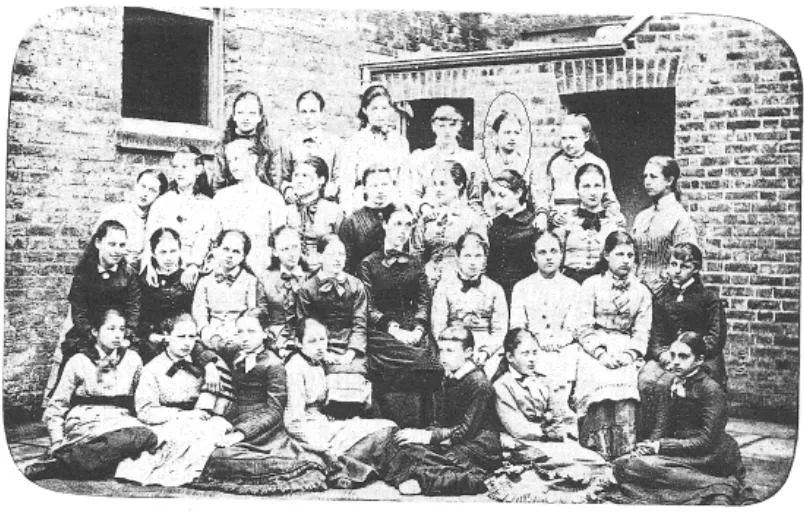
The only surviving picture of Mabel Haynes Bode, author of Pāli Literature of Burma and the Pāli edition of the Sāsanavaṃsa.41
The most important work related to Kacc published in the first half of the 20th century is the monumental edition of the Saddanīti by Helmer Smith with the assistance of Nils Simonsson (6 Vols. 1929–1966). In the critical apparatus, Smith refers to Kacc, Kacc-v and Nyāsa (abbreviated Mmd) whenever necessary. The critical apparatus itself contains a mine of materials for a comparative study of the Pāli grammarians. Although Smith did not publish any essay on the topic, his short preface to Sadd stands as a programmatic essay for the study of 12th century Sinhalese and Burmese grammarians and their successors.
After Franke’s study in 1902, historical research on Pāli grammar came to a halt. Heinrich Lüders’ Kātantra and Kaumāralāta, Berlin, 1930, is an exception to the rule. In 1957 Louis Renou devoted a short article on the similarities between Kacc and Kātantra (see Bibliography), but his contribution is of little significance in the field of Pāli studies. It is only in the late nineteen eighties that indigenous Pāli Grammar recovers a visible place in Pāli studies, and that is mainly due to O.H. Pind’s series of articles on Pali grammar and grammarians. Pind’s studies are in parallel to his labours on the Critical Pāli Dictionary. In his first papers (1989, 1990) Pind shows that Buddhaghosa’s grammatical analyses betray some knowledge of Pāṇini. Pind also states that later commentators, namely Mahānāma (6th c. A.D.42) and Buddhadatta (8th c. A.D.?43) used Pāṇinian grammar. Buddhadatta, however, seems to have also known Kacc or the Nyāsa.44 In 1997 Pind published a detailed survey of the history of Pali grammar and grammarians. The 1997 article was republished in 2012 with minor corrections in the Journal of the Pali Text Society. The time frame of Pind’s survey is approximately fifth to the tenth centuries CE and therefore it does not cover the rich period of Pali grammatical works including Aggavaṃsa and Moggallāna. Yet, it is the best available introduction on Pali indigenous grammar, more detailed and up to date than the introduction in U Thitzana’s book.
Pind has published the critical edition of Kacc and Kacc-v (PTS, 2013), which any user of U Thitzana’s edition should be advised to consult in parallel.
To conclude this survey I will list a few important contributions that make reference to Kaccāyana in recent scholarship: Tin Lwin publishes an important article on Sadd in 1991 where he compares Kacc and the Saddanīti. Tin Lwin marginally refers to the Nyāsa and he does not seem to be aware of Pind’s articles (1989, 1990). In 1992 Eivind Kahrs publishes a monograph on the kāraka section of the Saddanīti. In this extensive article Kahrs repeatedly makes reference to Kacc and Kacc-v. His notes on Kacc are based on Senart (1871) and Pind (1989, 1990). Kahrs mainly focuses on the relationship between Saddanīti and the Kāśikāvṛtti. In 2008 Mahesh Deokar publishes a comparative study of technical terms in Pāli and Sanskrit grammars, with a Foreword by E. Kahrs. Deokar’s study is preceded by a learned introduction where the author gives a full list of Asian publications related to Pāli Grammar. In 2004 Dwivedi, the learned editor of the Kātantra edition with five commentaries,45 published parallel tables of Kacc and Kātantra.46 In 2008 Eisel Mazard digitally published a revised edition of Charles Duroiselle’s Pali Grammar.47 Mazard’s introductory essay offers a vivid picture of Pāli grammatical studies in the late 19th century, to which I am much indebted in this account. Alastair Gornall completes a doctoral dissertation in 2012 on grammar and religion in Sri Lanka during the 12th century C.E. He is also the author of an important article on the broader implications of Pāli phonetics in his 2014 article “How Many Sounds are in Pāli?” There are of course other scholars working in the field but I have named only a representative list, by no means an exhaustive one.48
Observations on U Thitzana’s Kaccāyana
Section titled “Observations on U Thitzana’s Kaccāyana”This short survey sufficiently shows that in the history of Kaccāyana scholarship the motivations have varied: ranging from the quest for the original language of humankind to a more historical grammar. Where does U Thitzana’s work fit in here? U Thitzana’s work is not a standard academic book. The lack of scholarly precision is felt already in the Introduction. For instance, in p.7 the author says that Pāli, sanskrit and Prakrit “belong to the Indo-Aryan language family of the Indus civilization” and also that “Sanskrit became the sacred language of Hinduism and Vedic texts, while Pali being the sacred media for all Buddhist texts and Prakrit being the sacred language of Jains and their religious texts.”
In the Foreword of vol. 1, in the section Pali and its origin, there are a few inaccurate expressions such as: “The inscriptions written in Pāli dating back to third century B.C. have been found in Orissa, Bihar, Allahabad, Delhi, Pujab, Guzerat (Gujarat) and even in Afghanistan.” If the author is referring to the Asokan Inscriptions, they cannot be qualified as Pāli. The reader who may be interested in a more up to date discussion of the origin of Pali as the name of a language name and also its nature can refer to Kate Crosby’s article of 2004.
There are a number of typographical errors that could have been easily avoided. For example: p.8 asthtadhyāyī, read aṣṭādhyāyī; p.9 ādisabdikā, read ādiśabdikā; Janendara, read Jinendra (or Jainendra?); Pāṇinī, read Pāṇini; p.10 Kāsakrtsna, Apisāli and Sākatāyana read Kāṣakṛtsna, Apiśāli and Śākaṭāyana; Siddhanta Kaumudi read Siddhānta Kaumudī; Dikṣeta read Dikṣita, and so on. Referencing should also be added. For example, in vol.2, p. 9, there are two verses in Devanagari script, this time with a perfect spelling of the names of the grammarians:
indraś candraḥ kāśakṛtsnāpiśalī śākaṭāyanaḥ ||
pāṇinyamarajainendrāḥ jayantyaṣṭādiśābdikāḥ || ||
indraṃ (read aindraṃ) cāndraṃ kāśakṛtsnaṃ komāraṃ śākaṭāyanam ||
sārasvtaṃ (read sārasvataṃ) cāpiśalaṃ śākalyaṃ pāṇinīyakam || ||
The first stanza is from Vopadeva’s Kavikalpadruma, verse 2,49 but we do not have any mention of the source of the verses.
The presentation of the Pāli text is problematical, as it is a copy pasted version of the online CSCD version,50 including typos (e.g. vol. 2, p. 126, Kacc 11. adhoṭhataṃ instead of adhoṭhitaṃ “placed below”, a typo inherited from the CSCD verison). In Vol. 1, for instance, on p.11 the thread of suttas begins with double numeration:
1,1. Attho akkharasaññāto
[…]
9,11. Paramanaññā payoge
The student has to go to vol.2, p.57 to learn that the first number is the rule in Kacc and the second in Rūpasiddhi. It is not necessary to give the Rūpasiddhi numeration in an introduction to Kacc as it may create confusion.
Since the suttapāṭha is already found in vol. 2 it is difficult to understand the use made of it in vol.1 and the unnecessary redundancy.
Another editorial decision that is difficult to understand is that the members of dvanda samāsa are separated by a comma instead of the conventional (but not even necessary) hyphen: e.g. vol.2 p.13 ya,va,kārā ca instead of yavakārā ca. Derived from this decision is the inconvenient use of the apostrophe to mark sandhi. For instance, in Kacc 10, the editor prints the text as follows:
pubba’madhoṭhita’massaraṃ sarena viyojaye
Another random example with an unnecessary and confusing apostrophe, vol.1, p.22:
316, 331. Nāmānaṃ samāso yutta’ttho.
The author’s justification for marking the sandhi is that Roman script differs from Indic scripts, but this reason is unconvincing: many editions look better following the usual conventions. I see no reason why Pind’s edition has not been used as a reference. If sandhi is to be marked at all, it is probably better to separate words, pubbam’adhothitam’assaraṃ, etc. and not as if the editor would have cut the akkhara as printed in Devanagari or Burmese.
All the text given in vol. 1 (redundantly in different scripts) is printed again in vol. 2. The purpose, perhaps, is to keep vol.1 as a reference for other passages when using vol. 2, and that is not a bad idea considering that we often need to jump to suttas that are far away in order to understand the derivation in one particular sutta.
Regarding the main part of the book, which consists of the Pali text plus a translation and explanatory notes, there is no doubt that, being a complete treatment of Kacc, it can be of great use to beginners and succeeds in clarifying many obscure aspects of the often cryptic vyākaraṇa language. This translation is especially recommended to those who study Pāli in order to better understand the Buddha’s teachings, because it provides the exact nuance of technical terms as they are to be understood according to the Buddhadhamma. For instance, in vol.2, p.421, the word appaṭivedhā is translated “for not penetrating (by means of insight knowledge, path and fruition knowledge)”. This translation is perfectly in accordance with the meaning of the word as found in the Tipiṭaka. A more literal rendering (viz. “for not penetrating”) would miss the most important part of it. We shall keep in mind that the original purpose of the Kacc grammar was not to serve the interest of comparative philologists but to help practitioners. This is made clear by the adhikārasutta Kacc 52 jinavacanayuttaṃ hi “Only what conforms to the Buddhist texts [shall be applied throughout this grammar]” (see vol.2, p.183). In this respect, U Thitzana’s translation is closer to the original spirit than its predecessors Senart and Vidyabhusana.
The list of suffixes and affixes is very useful as an index. The guide to nominal derivation in vol.2, p. 396 is very useful for understanding the mechanisms of word formation step by step. It is however redundant as a similar section is found in vol. 2, p.829.
In vol.2, pp. 33-34 the tables explaining the types of suttas are also a good idea. In many scholarly publications this information is taken for granted, as if it was clear enough to anyone. U Thitzana provides a detailed chart that is clear and to the point. One detail the English student should note is that U Thitzana translates akkhara as “syllable”, when sometimes it does not refer to an entire syllable but simply one sound. For example, on p.34 āgama: “inserts a new syllable” when it rather insterts a new sound (the “syllabe ya” actually means the sound y).
A special strong point of the book is the detailed explanations following the traditional style, such as the twenty pages on upasaggas and nipātas, not originally in Kaccāyana, that we find in the author’s commentary on sutta 221 sabbāsamāvusopasagganipātādīhi ca “All (the singular and plural of “paṭhamā, dutiyā, tatiyā, catutthī, pañcamī, chaṭṭhī, sattamī”) vibhattis, applied after Upasagga and Nipāta words, including vocative particle āvuso, are to be elided.”
When Pāli texts are cited in the examples of the sutta, no reference is given, and should be given. The same applies when suttas are cited without reference to number. Here again, using Pind’s edition would have been more useful for the student because it indicates when examples that are derived from Pāli usage and when they are not.
Notwithstanding these shortcomings, the great effort put into this translation has to be welcome, especially coming from a Burmese expert with a refined scholastic education. The fully translated and anotated text in one volume certainly comes in handy. It is not a work for academics but for beginners and for those who wish to have a taste of Pāli grammar in the way it has been taught for centuries in Buddhist monasteries. It is by far the most complete English rendering of the Kacc grammar ever done.
REFERENCES
Section titled “REFERENCES”- Andersen, D. and Smith, H. 1921. The Pāli Dhātupāṭha and the Dhātumañjūsā, Edited with Indexes, Copenhagen.
- Bode, M.H. 1909. The Pali Literature of Burma. London.
- — 1908. “Early Pali Grammarians in Burma”. Journal of the Pali Text Society 6: 81-101.
- — ed. 1898. Sāsanavaṃsa. London: Pali Text Society.
- Burnell, A.C. 1875. On the Aindra School of Sanskrit grammarians. Mangalore.
- Clough, B. 1824. A Compendious Pali Grammar with a Copious Vocabulary in the Same Language. Colombo: Wesleyan Mission Press.
- Crosby, Kate. 2004. “The Origin of Pāli as a Language Name in Medieval Theravāda Literature”. Journal of the Centre for Buddhist Studies, Sri Lanka 2: 70-116.
- D’Alwis, J. 1863. An introduction to Kachchāyana’s grammar of the Pāli language, with an introduction, appendix, notes, etc, London.
- Deokar, M.A. 2008. Technical Terms and Technique of the Pali and the Sanskrit Grammars. Varanasi: Central Institute of Higher Tibetan Studies.
- Dwivedi, J.P. 1997—2005. Kātantravyākaraṇa of Ācārya Śarvavarmā, with four commentaries: Vṛtti and Ṭīkā by Śri Durgha Singh; Kātantravṛttipañjikā by Śri Trilocanadāsa; Kalāpacandra by Kavirāja Suṣeṇaśarmā; Samīkṣā by the editor. Sarnath. Varanasi.
- Dwivedi, J.P. and Kumar, S. eds. 2004. A Comparative and Critical Study of Kātantra and Kaccāyana Grammars, Bibliotheca Indo-tibetica Series, 56, Central Institute of Higher Tibetan Studies. Sarnath.
- Franke, R.O. 1902. Geschicte und Kritik der einheimischen Pāli-Grammatik und -Lexicographie. Strasbourg: Trübner & Co.
- Fryer, G.E. 1882. “Note on the Pali Grammarian Kacchāyana”. Journal of the Asiatic Society. 116-127.
- Gornall, A.M. 2014. “How Many Sounds are in Pāli? Schism, Identity and Ritual in the Theravāda saṅgha”. Journal of Indian Philosophy 42 (5): 511-550..
- — 2012. “Buddhism and Grammar: The Scholarly Cultivation of Pali in Medieval Laṅkā.” PhD thesis, University of Cambridge.
- Gornall A.M. and Gunasena, A. 2018. “A History of the Pali Grammatical Tradition of South and Southeast Asia by Vaskaḍuvē Subhūti (1876), Part I”. Journal of the Pali Text Society 33: 1-54.
- Grünwedel, A. 1883. Das sechste kapitel der Rūpasiddhi: nach drei Singhalesischen Pali-handschriften. Berlin: Schade’s Buchdruckerei.
- Kahrs, E. 1992. “Exploring the Saddanīti”. Journal of the Pali Text Society 17: 1–212.
- Kuhn, E.W.A. 1870. Kaccāyanappakaraṇae specimen alterum, Halle.
- Kuhn, E.W.A. 1869. Kaccāyanapakaraṇae specimen. Berlin: Verlag de Akademie der Wissenschaften.
- Lüders, H. 1930. Kātantra und Kaumāralāta. Berlin, Verlag der Akademie der Wissenschaften.
- Malalasekera, G.P. 1928. The Pāli Literature of Ceylon. London.
- Mason, F. 1868. A Pali Grammar on the Basis of Kacchayano, with Chrestomathy and Vocabulary. Toungoo: Institute Press.
- Norman, K.R. 1983. Pāli Literature. A history of Indian literature Vol. VII, Fasc. 2. Otto Harrassowitz: Wiesbaden.
- Nyunt, P. 2012. Catalogue of the Piṭaka and Other Texts in Pāḷi, Pāḷi-Burmese, and Burmese (Piṭakat-tō-sa-muiṅ) by Maṅ:krī: Mahāsirijeya-sū. Bristol: Pali Text Society.
- Palsule, G.B. 1954. Kavikalpadruma of Vopadeva. Poona: Deccan College Monograph Series.
- Pind, O.H. 2012. “Pali Grammar and Grammarians from Buddhaghosa to Vajirabuddhi: A Survey”. Journal of the Pali Text Society 31: 57-124.
- — 2013. Kaccāyana and Kaccāyanavutti. Bristol: Pali Text Society.
- — 1990. “Studies in the Pāli Grammarians II”. Journal of the Pali Text Society 13: 175-218.
- — 1989. “Studies in the Pāli Grammarians I”. Journal of the Pali Text Society 31: 33-82.
- Oung, T.D. 1899–1902. A grammar of the Pāli language (after Kaccāyana), in 4 volumes, Akyab.
- Renou, L. 1959. “Kaccāyana et le Kātantra” in Études Vediques et Pāṇinéennes, Vol. 3, Paris, 127–133.
- Ruiz-Falqués, A. 2015. “A Firefly in the Bamboo Reed: The Suttaniddesa of Chapaṭa Saddhammajotipāla and the Grammatical Foundations of Theravāda Buddhism in Burma,” PhD thesis, University of Cambridge.
- — 2017. “On the Authorship of Kaccāyana, the Oldest Pāli Grammar.” Studies in Pāli Language and Literature : 251-268.
- Saini, R.S. 2007. Post-Pāṇinian Systems of Sanskrit Grammar. Delhi: Parimal Publications.
- Senart, E. 1871. Kaccàyana et la littérature grammaticale du Pâli. Paris: Journal Asiatique.
- Smith, H and Simonsson, N. 1928–1956. Saddanīti: la grammaire palie d’Aggavaṃsa. Lund: C.W.K. Gleerup.
- Turnour, G. 1837. The Mahāwanso in Roman Characters with the Translation Subjoined and an Introductory Essay on Pali Buddhistical Literature, in Two Volumes. Vol. 1. Ceylon: Cotta Church Mission Press.
- Vidyabhusana, S.C. 1901. Kaccayana’s Pali Grammar, Edited in Devanagari Character and Translated into English. Calcutta: Mahabodhi Society.
Footnotes
Section titled “Footnotes”-
I would like to thank William Pruitt, Alastair Gornall and the two blind reviewers for their helpful comments and corrections in the process of writing this review. ↩
-
See Andersen and Smith, The Pāli Dhātupāṭha and the Dhātumañjūsā, Edited with Indexes, Copenhagen, 1921. This edition is based on manuscripts obtained by Rasmus Rask, the father of comparative linguistics, in his trip to Ceylon in 1821. ↩
-
Turnour (1837: xxv). ↩
-
See Cecil Bendall, William Tolfrey, in Dictionary of National Biography 1885–1900, vol. 56, published in 1898, available online: https://en.wikisource.org/wiki/Tolfrey,_William_(DNB00) (last accessed July, 2018). The obituary was originally published in The Gentlemen’s Magazine (1818: 185). ↩
-
Gornall and Gunasena (2018: 38). ↩
-
Bendall, ibid. ↩
-
Ibid. ↩
-
Clough (1824: iv). ↩
-
Mason (1868: iii). Mason further is quoted in D’Alwis (1863, ii): “The grammar reputed to have been written by Kachchàyana still exists. I had a copy made from the palm-leaf, on small quarto paper, and the Pali text occupies between two and three hundred pages, while the Burmese interpretation covers more than two thousand. I made a compendium of the whole Pali and English, a few years ago, on the model of European Grammars, which might be printed in one or two hundred pages, and convey all the information contained in the two or three thousand in manuscript” (Am. Or. Journal, iv. p. 107). For one who knew Burmese, as F. Mason did, the Kaccāyana tradition in Burma had to seem everything but dead. ↩
-
Mason (1868: viii). Italics are mine. ↩
-
See Urs App, William Jone’s Ancient Theology, Sino-Platonic Papers, Number 191, University of Pennsylvania, July 2009: http://sino-platonic.org/complete/spp191_william_jones_orientalism.pdf (Last accessed July, 2018) ↩
-
Mason (1868: iii). ↩
-
http://www.rootsweb.ancestry.com/~lkawgw/gen3137.html (First accessed, 28/05/13). Link already broken in July 2018. ↩
-
D’Alwis (1863: ii-iii). ↩
-
D’Alwis (1863, cxxxiii). ↩
-
Source: SWRD Bandaranaike Museum: http://flickriver.com/search/d'alwis (Last accessed July 2018) ↩
-
Aside from being one of the founders of Ethnology as an academic discipline, Bastian wrote extensively about his travels. The diaries and notes of his journey in southeast Asia were published in six volumes under the title Die Völker des östlichen Asien (Jena, 1866-1871). ↩
-
Senart (1871: 94): ‘Nous avons visiblement affaire à une collection d’observations grammaticales bien plus qu’à une grammaire méthodique, où chaque mot serait pesé et les limites naturelles de chaque règle seraient nettement définies.’ ↩
-
Fryer (1882: 118). ↩
-
Fryer (1882: 119). Underlined is mine. ↩
-
Fryer (1882: 121). ↩
-
Fryer (1882: 122). ↩
-
Fryer (1882: 125). ↩
-
Fryer (1882: 125). ↩
-
Fryer (1882: 126). ↩
-
Nyunt (2012: 79). ↩
-
For a more detailed discussion on this problem of authorthip see Ruiz-Falqués, 2017. There is an error in this article that needs to be corrected: Ariyālaṅkāra was the author of the pūrāṇaṭīkā “old commentary”, not of the navaṭīkā “new commentary”, which is anonymous and probably later than Ariyālaṅkāra. ↩
-
I must thank Eisel Mazard for discovering this work to me, back in 2011, and most importantly for informing me of the existence of a complete set in the archives of the Library of the Faculty of Asian and Middle Eastern Studies, Cambridge University. ↩
-
Oung (1902: Preface). ↩
-
Vidyabhusana (1901: xii). ↩
-
Vidyabhusana (1901: xviii). ↩
-
Malalasekera (1928: 180). ↩
-
Vidyabhusana (1901: xxvi). ↩
-
Vidyabhusana (1901: xlii): “My best thanks are also due to Prof. E. Senart of Paris whose excellent edition of Kaccāyana I have frequently used.” ↩
-
Franke (1902: 14). ↩
-
Franke (1902: 21). ↩
-
Franke (1902: 22). ↩
-
I have not included this work in the survey because it was originally in Sinhalese, not in a European language.. ↩
-
Bode (1908: 93). ↩
-
Nyunt (2012: 76). ↩
-
http://www.users.globalnet.co.uk/~hoz/milton/mabel.html (Last accessed July, 2018). ↩
-
Norman (1983: 132). ↩
-
Norman (1983: 146). The date is disputed. ↩
-
Pind (1990: 211). ↩
-
See References. ↩
-
Dwivedi and Kumar, 2004. ↩
-
Mazard’s edition of Duroiselle’s Pali Grammar is available on Google Books. ↩
-
Outside the mainstream academic circuit, but intertwined with it, we find the Yahoo Pali List, a mailing list moderated and curated by Jim Anderson, whose archives contain a great number of important discussions on grammatical points and traditional grammars. Another relevant resource is Venerable Bhikkhu Anandajoti’s website: www.ancient-buddhist-texts.net, which has a section on philological topics. ↩
-
Palsule (1954: 1); see also Saini (2007: 45 n.1). ↩
-
Chaṭṭha Saṅgāyana CD.The Tipiṭaka, commentaries and ancillary works mainly based on the printed editio of the Sixth Council in Burma (1954–56), accessible online in several scripts: www.tipitaka.org. Note that U Thitzana’s teacher, the Venerable Sayādaw Bhaddanta Sūriyābhivaṃsa (1879–1975) was the chief presiding patriarch chairman of the Sixth Council (vol.2, p.4). ↩